

TRAINING DAYS: 5
(4 days of training + 1 day exam)
CPD CERTIFICATION
31 Credits
EXAM DURATION
3 Hours
EXAM RETAKE POSSIBLE?
Yes. Free one more exam in 12 months
WHAT IS INCLUDED?
Training, PECB exam and certification
Certified Artificial Intelligence Professional (CAIP) Training
An Artificial Intelligence (AI) Professional is a specialist equipped with the knowledge and skills to design, implement, and manage AI systems that drive innovation and efficiency across various industries. AI professionals combine technical expertise in areas like machine learning, deep learning, natural language processing, and computer vision with strategic insights to ensure the ethical and responsible deployment of AI solutions.
Key Responsibilities of an AI Professional:
- Data Analysis: Preparing, cleaning, and transforming data to ensure the quality of AI outputs.
- AI Systems Development: Building AI models using machine learning algorithms, neural networks, and data-driven approaches.
- AI Risk Management: Identifying and mitigating risks such as bias, privacy concerns, and compliance issues.
- Strategic Alignment: Integrating AI solutions into organizational strategies to maximize business impact.
- Ethical AI Deployment: Ensuring AI systems uphold principles of fairness, accountability, and transparency.
By excelling in these areas, AI professionals play a crucial role in advancing organizational goals while promoting responsible innovation.
Why Should You Consider Being a Certified Artificial Intelligence Professional (CAIP)?
The Certified Artificial Intelligence Professional (CAIP) certification provides a comprehensive framework for mastering AI concepts, tools, and strategies. It is designed for professionals seeking to enhance their expertise in one of the most transformative fields of our time.
This certification validates your ability to implement AI technologies effectively, ensuring organizations benefit from AI-driven solutions that are both innovative and compliant with ethical standards. By earning the CAIP certification, you demonstrate proficiency in key areas of advanced AI technology and governance.
The certification also highlights your commitment to staying updated with the latest AI advancements and your ability to address challenges such as data quality, algorithmic bias, and compliance with AI regulations. As AI continues to reshape industries, the CAIP credential positions you as a trusted expert capable of leading AI initiatives with confidence.
.
Learning objectives
By the end of this training course, the participants will be able to:
- Explain the foundational principles of AI and its various applications.
- Conduct data analysis and create meaningful visualizations to support AI projects.
- Apply machine learning techniques to real-world problems, including supervised, unsupervised, and reinforcement learning.
- Implement simple neural network and advanced deep learning architectures such as CNNs.
- Understand NLP systems and Computer Vision methodologies.
- Understand robotics and expert systems for AI-driven automation.
- Identify and mitigate AI risks while ensuring compliance with regulations.
- Develop ethical AI strategies aligned with organizational values and societal needs.
Download Certified Artificial Intelligence Professional (CAIP) Course Brochure
Educational approach
- Comprehensive Curriculum: The course combines theoretical knowledge with real-world examples to ensure participants gain both fundamental and advanced AI concepts.
- Practical Exercises: Hands-on activities and projects simulate real-life scenarios, enabling participants to apply their skills effectively.
- Interactive Learning: Group discussions and collaborative tasks for deeper engagement and shared learning experiences.
- Certification Readiness: The course includes quizzes and exercises that closely align with the certification exam format.
Prerequisites
A general understanding of basic programming knowledge is recommended.
Course Agenda
Day 1: Foundations of AI and Data Analysis
Day 2: Machine Learning
Day 3: Deep Learning and Natural Language Processing
Day 4: Computer Vision, Robotics, AI Strategy, Governance, and Risk Management
Day 5: Certification exam
Examination
The “Certified Artificial Intelligence Professional” exam meets the requirements of the PECB Examination and Certification Program (ECP). It covers the following competency domains:
Domain 1: Fundamental principles and concepts of an artificial intelligence management system
Domain 2: Apply data analysis and visualization
Domain 3: Develop Machine Learning models using Python
Domain 4: Establish governance frameworks to integrate AI
General Information
- Certification and examination fees are included in the price of the training course
- An attestation of course completion worth 31 CPD (Continuing Professional Development) credits will be issued to the participants who have attended the training course.
- Candidates who have completed the training course but failed the exam are eligible to retake it once for free within a 12-month period from the initial date of the exam.
Certification
After successfully passing the exam, you can apply for one of the credentials shown below. You will receive the certificate once you comply with all the requirements related to the selected credential. The requirements for the Certified Artificial Intelligence Professional certification are as follows:
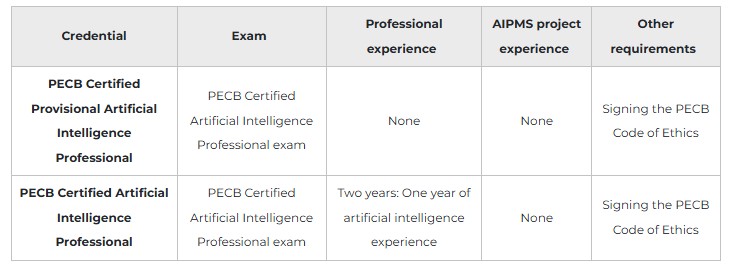
To be considered valid, the implementation activities should follow best implementation and management practices and include the following:
- Fundamental data analysis, visualization, and preprocessing techniques
- General knowledge and Implementation of machine learning algorithms, covering supervised and unsupervised machine learning models.
- Hands-on expertise and fundamental knowledge of concepts in deep learning.
- Develop and enforce AI governance, ethics, and risk management frameworks, ensuring transparency, fairness, and compliance
- Cross-functional collaboration to align AI initiatives with business objectives and oversee data-driven projects focused on management and analysis.