

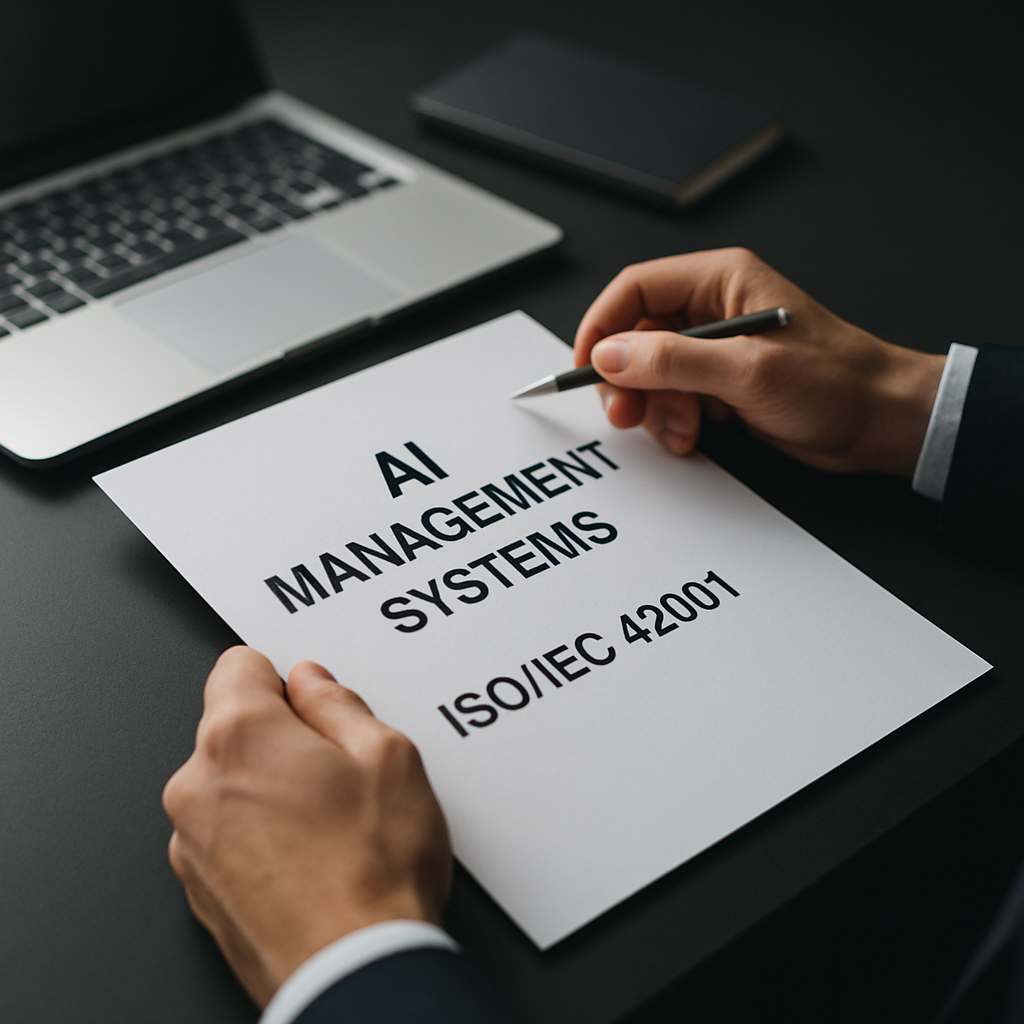
Understanding the Rising Regulatory Risks of AI Management
The rapid integration of artificial intelligence (AI) into diverse industry sectors has fundamentally transformed operational workflows, enabling organizations to achieve unprecedented levels of automation, scalability, and analytical insight. However, this technological acceleration has also introduced a complex array of systemic risks that extend far beyond traditional IT security concerns. Mastering ISO/IEC 42001 standard became a viable option to mitigate the AI risks for many executives. Indeed, board members are now subject to increased scrutiny as global regulatory frameworks evolve, imposing stringent requirements for robust governance over the entire AI lifecycle. The ISO/IEC 42001 emerges as a critical international standard specifically designed to address these challenges by establishing a structured framework for managing AI lifecycle risks, ethical dilemmas, and compliance obligations.
Failure to align with ISO/IEC 42001 exposes organizations to a spectrum of adverse outcomes, including regulatory penalties, loss of Digital Trust, reputational harm, and erosion of competitive advantage. In highly regulated industries such as financial services, healthcare, and critical infrastructure, the absence of standardized AI controls can precipitate cascading failures, trigger legal liabilities, and result in negative audit findings that threaten business continuity. For example, an unmitigated bias in an AI-powered loan approval system could lead to violations under the EU GDPR (General Data Protection Regulation) or Equal Credit Opportunity Act (ECOA), resulting in fines and mandatory remediation measures. As regulators increasingly demand demonstrable evidence of responsible AI management, organizations must proactively adopt comprehensive standards like ISO/IEC 42001 to safeguard their operational resilience and market reputation.
Industry Leaders Setting the Benchmark in AI Governance
Pioneering enterprises have begun embedding the principles of ISO/IEC 42001 directly into their AI governance frameworks, thereby positioning themselves as trusted innovators and setting new benchmarks for responsible technology adoption. These organizations implement risk-based AI management processes that are meticulously aligned with the core domains outlined in ISO/IEC 42001: systematic risk assessment, data quality assurance, transparency, accountability, and continuous monitoring. By adopting these best practices early, they not only enhance their compliance posture but also anticipate emerging regulations such as the European Union Artificial Intelligence Act (EU AI Act) and the United States Algorithmic Accountability Act.
Industry leaders report measurable improvements in AI system reliability, significant reductions in bias-related incidents, and streamlined audit readiness through the use of automated documentation and traceability tools. For instance, a leading healthcare provider leveraged ISO/IEC 42001-aligned controls to reduce diagnostic errors in its AI-driven imaging platform, resulting in improved patient outcomes and positive regulator feedback. Their success stories underscore the strategic value of proactive AI management, demonstrating how adherence to recognized standards can drive both innovation and sustainable compliance.
Quantifying the Business Value and Reducing Liability Exposure
Implementing ISO/IEC 42001 delivers tangible business benefits by systematically mitigating financial, operational, and reputational risks associated with AI deployment. Organizations realize direct cost savings through the minimization of regulatory fines, reduction in post-incident remediation efforts, and avoidance of costly litigation stemming from AI system failures or unintended consequences. Robust AI management practices also bolster stakeholder confidence, facilitating strategic partnerships and accelerating customer acquisition in an environment where Digital Trust is paramount.
The emphasis on traceability and thorough documentation within ISO/IEC 42001 simplifies both internal audits and external certification processes, reducing time-to-market delays caused by compliance bottlenecks. For example, a fintech company achieved faster product launches by integrating automated model validation logs and explainability reports, satisfying both internal auditors and external regulators. Ultimately, ISO/IEC 42001 transforms AI governance from a reactive compliance exercise into a strategic enabler of sustainable innovation, operational excellence, and enduring Digital Trust.
“Organizations that treat ISO/IEC 42001 as a foundational pillar—rather than a checkbox exercise—are better positioned to adapt to evolving regulatory demands and leverage AI responsibly for long-term growth.”
Bridging Strategy to Technical Implementation under ISO/IEC 42001
Translating high-level AI governance mandates into actionable technical controls requires a multidisciplinary approach that bridges strategy, compliance, and engineering. ISO/IEC 42001 prescribes detailed requirements encompassing AI risk identification, mitigation strategies, and performance metrics, all of which must be seamlessly integrated into existing enterprise risk management (ERM) frameworks, IT security policies, and data governance architectures. This often involves establishing automated workflows for continuous AI model validation, real-time bias detection, and rigorous explainability measures.
Successful implementation depends on cross-functional collaboration between compliance officers, data scientists, and cybersecurity professionals to embed control points throughout the AI development lifecycle. For example, regular joint reviews ensure that risk assessments remain current after each model retraining or major environmental change. Additionally, organizations must deploy robust logging and monitoring infrastructures capable of generating auditable evidence that demonstrates conformity to ISO/IEC 42001 requirements. As global regulatory expectations escalate, mastering this bridge ensures that organizations are not only compliant but also resilient against emergent AI risks and threats.
Technical Deep Dive: ISO/IEC 42001 AI Management Systems
Access the full technical implementation guide, NIST/ISO control mappings, and auditor notes in our Knowledge Base.
Strategic Roadmap: Operationalizing ISO/IEC 42001 AI Management Systems
To transition from theory to operational excellence, follow this path with Linqs:
- Phase 1: Compliance Gap Assessment – Baseline your current posture against ISO/IEC 42001 AI Management Systems requirements.
- Phase 2: Targeted Training – Bridge skills gaps via Linqs Assurance & Audit Services.
- Phase 3: Automated Monitoring – Deploy LinqsOne to maintain continuous compliance.
Comments are closed