

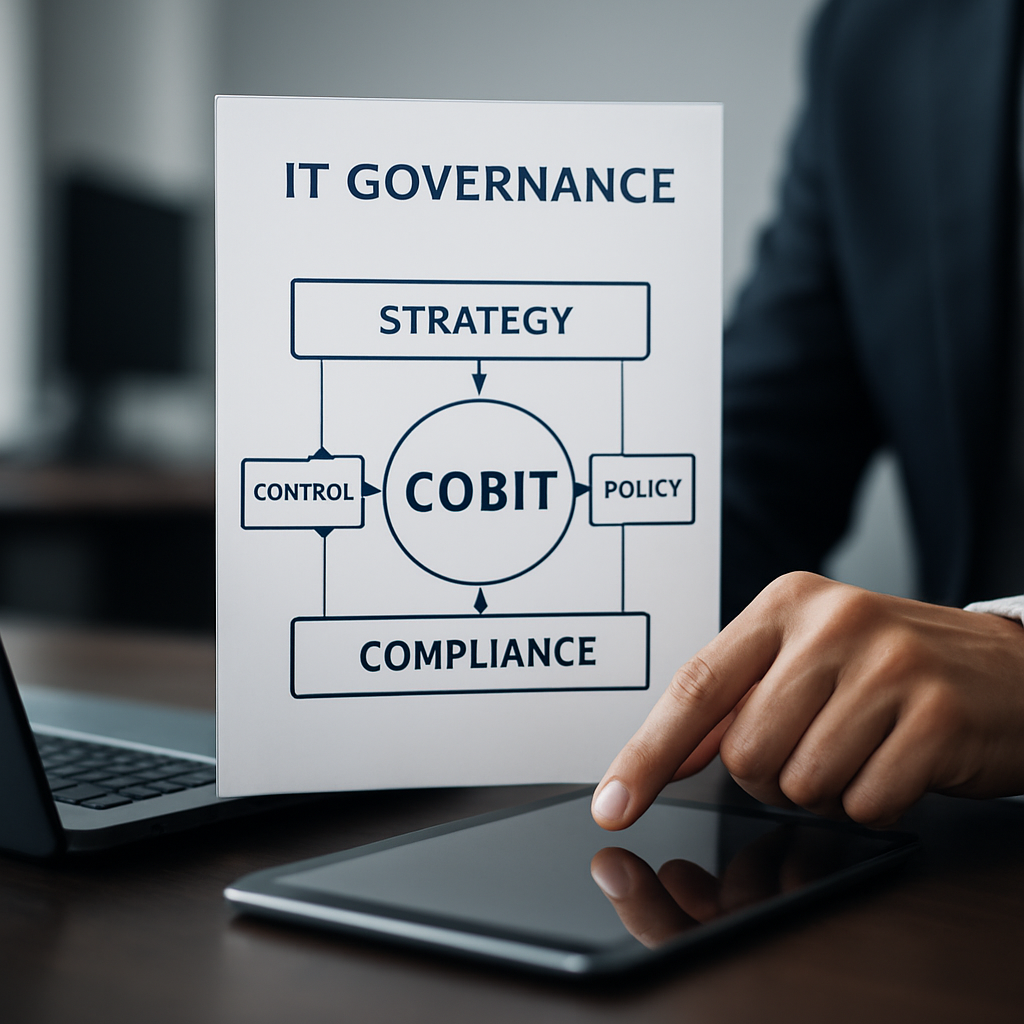
Unveiling the Risk Landscape in IT Governance
In today’s hyper-connected digital economy, organizations are increasingly exposed to a complex spectrum of risks that stem from ineffective IT governance frameworks. Executives are now getting more pressure in elevating IT governance with COBIT or other similar models. The absence of a robust control environment not only amplifies vulnerability to cyber threats but also introduces significant challenges related to regulatory non-compliance and operational inefficiencies. These weaknesses can quickly erode shareholder value, especially as Digital Trust becomes an essential asset for any enterprise.
Regulatory mandates such as the General Data Protection Regulation EU GDPR (General Data Protection Regulation), Sarbanes-Oxley Act (SOX), HIPAA (Health Insurance Portability and Accountability Act), and the latest updates to the National Institute of Standards and Technology Cybersecurity Framework (NIST) have raised the stakes for compliance. Failure to align IT governance with business objectives results in critical vulnerabilities, including mismanaged data privacy, inconsistent risk management practices, and fragmented accountability across IT and business units. For C-suite executives, these gaps translate directly into reputational damage, legal penalties, and diminished stakeholder trust—risks that are intolerable in a climate where Digital Trust is synonymous with organizational credibility.
The strategic imperative for adopting a recognized framework like Control Objectives for Information and Related Technologies (COBIT) has never been more urgent. COBIT provides a comprehensive model for governing enterprise IT by integrating risk management, compliance, and performance optimization within a unified system. This ensures that technology investments deliver measurable business value while mitigating emerging cyber and regulatory risks through structured controls and continuous improvement cycles.
“Executives must recognize that regulatory scrutiny is intensifying globally. Adopting COBIT not only streamlines compliance but also creates a defensible posture during audits, reducing the likelihood of costly enforcement actions.”
Industry Leaders Setting the Benchmark with COBIT
Global enterprises, including financial institutions, healthcare conglomerates, and government agencies, have increasingly adopted COBIT 2019 as their foundational IT governance framework. These organizations leverage COBIT’s detailed processes and governance components to enforce accountability at all levels, ensuring alignment with international standards such as ISO/IEC 38500 and Information Technology Infrastructure Library (ITIL).
For example, leading banks utilize COBIT to integrate risk assessment tools with real-time monitoring systems, enabling them to respond rapidly to evolving threat vectors and shifting compliance landscapes. Healthcare providers deploy COBIT-aligned workflows to manage patient data privacy under HIPAA (Health Insurance Portability and Accountability Act) requirements, demonstrating due diligence during regulatory examinations. Government agencies use COBIT to harmonize IT operations with public sector mandates, achieving transparency and audit readiness.
Enterprises deploying COBIT report enhanced ability to demonstrate due diligence and audit readiness during regulatory examinations. This proactive stance reduces operational downtime caused by compliance failures and bolsters investor confidence through transparent governance reporting. The convergence of COBIT with agile and DevOps methodologies empowers industry frontrunners to accelerate innovation without sacrificing control or security, creating a competitive advantage in fast-moving markets.
Auditor Note: “Organizations that embed COBIT into their IT governance structure consistently outperform peers in regulatory audits. Automated evidence collection and integrated dashboards simplify auditor review, minimizing disruption and remediation costs.”
Unlocking Value: ROI and Liability Mitigation Through COBIT
Investing in COBIT-driven IT governance delivers quantifiable returns, both tangible and intangible. By instituting formalized controls aligned with business goals, organizations reduce incidents of data breaches, service interruptions, and non-compliance fines. The framework’s structured approach facilitates precise resource allocation by prioritizing high-impact risk areas, thereby optimizing IT spend efficiency and maximizing return on investment (ROI).
From a liability perspective, COBIT provides a defensible governance structure that satisfies auditors and regulators alike. It documents decision rights, risk ownership, and control effectiveness, collectively mitigating executive and board-level liability exposure. Firms adopting COBIT often experience accelerated audit cycles and reduced remediation costs, enhancing overall corporate resilience and market reputation.
- Implementing COBIT enables organizations to track and document every governance decision, which is vital for demonstrating compliance with SOX Section 404 and similar mandates. This level of documentation protects executives from personal liability and supports swift resolution of regulatory inquiries.
- By aligning IT strategy and risk management, COBIT helps companies avoid costly downtime and reputational harm resulting from compliance failures. Industry examples include multinational corporations that have reduced regulatory fines by automating policy enforcement and incident response workflows.
- COBIT’s maturity models facilitate iterative enhancement of control effectiveness, allowing organizations to continuously improve their governance posture. This adaptability is crucial for maintaining compliance amid evolving regulatory requirements and technological advancements.
Translating Strategy into Technical Execution with COBIT
While COBIT articulates governance principles at a strategic level, successful implementation demands meticulous translation into actionable technical controls. Organizations must integrate COBIT’s governance objectives with IT service management tools, cybersecurity frameworks, and risk assessment technologies to ensure seamless execution.
Mapping COBIT’s domains—Evaluate, Direct and Monitor (EDM), Align, Plan and Organize (APO), Build, Acquire and Implement (BAI), Deliver, Service and Support (DSS), and Monitor, Evaluate and Assess (MEA)—to existing enterprise architectures and workflows is a critical step. This process involves identifying overlaps and gaps between COBIT controls and current operational practices, then designing automated compliance monitoring and incident response orchestration programs anchored on COBIT metrics.
- Deploying automated compliance monitoring tools ensures real-time visibility into control effectiveness, supporting continuous improvement initiatives. Industry leaders use Security Information and Event Management (SIEM) platforms to collect and analyze governance data, facilitating rapid detection and correction of deviations.
- Embedding COBIT’s maturity models enables organizations to benchmark progress and refine technical controls iteratively. For example, cloud service providers integrate COBIT with data privacy initiatives to address hybrid IT environments, ensuring consistent governance across on-premises and cloud assets.
- Practical execution requires cross-functional collaboration between IT, compliance, and business units. Establishing governance councils and regular training sessions fosters a culture of accountability and regulatory awareness, reducing manual errors and policy fragmentation.
Mastering the technical integration of COBIT is essential for achieving resilient, compliant, and value-driven IT governance. Enterprises that invest in automation, skills development, and adaptive governance structures position themselves for sustained success in a volatile regulatory landscape.
Technical Deep Dive: IT Governance / COBIT
Access the full technical implementation guide, NIST/ISO control mappings, and auditor notes in our Knowledge Base.
Strategic Roadmap: Operationalizing IT Governance / COBIT
To transition from theory to operational excellence, follow this path with Linqs:
- Phase 1: Compliance Gap Assessment – Baseline your current posture against IT Governance / COBIT requirements.
- Phase 2: Targeted Training – Bridge skills gaps via Linqs Assurance & Audit Services.
- Phase 3: Automated Monitoring – Deploy LinqsOne to maintain continuous compliance.
Comments are closed